
Impressions
Recorded instances where an advertisement was shown according to the advertising platform.
Does not automatically prove brand awareness or sales.Understand what your paid advertising data actually shows. W3 Media turns available PPC campaign metrics into clearer reporting around advertising activity, costs, clicks, configured conversions and meaningful campaign trends.
PPC reporting is the process of organising, reviewing and explaining data generated by paid advertising campaigns. Reports can cover metrics such as impressions, clicks, advertising cost, click-through rate, cost per click and configured conversions while providing context around what those measurements mean.
PPC reporting explains measured campaign performance. Ongoing bid changes, budget adjustments, keyword refinement, ad testing and campaign optimisation belong primarily to PPC Campaign Management.
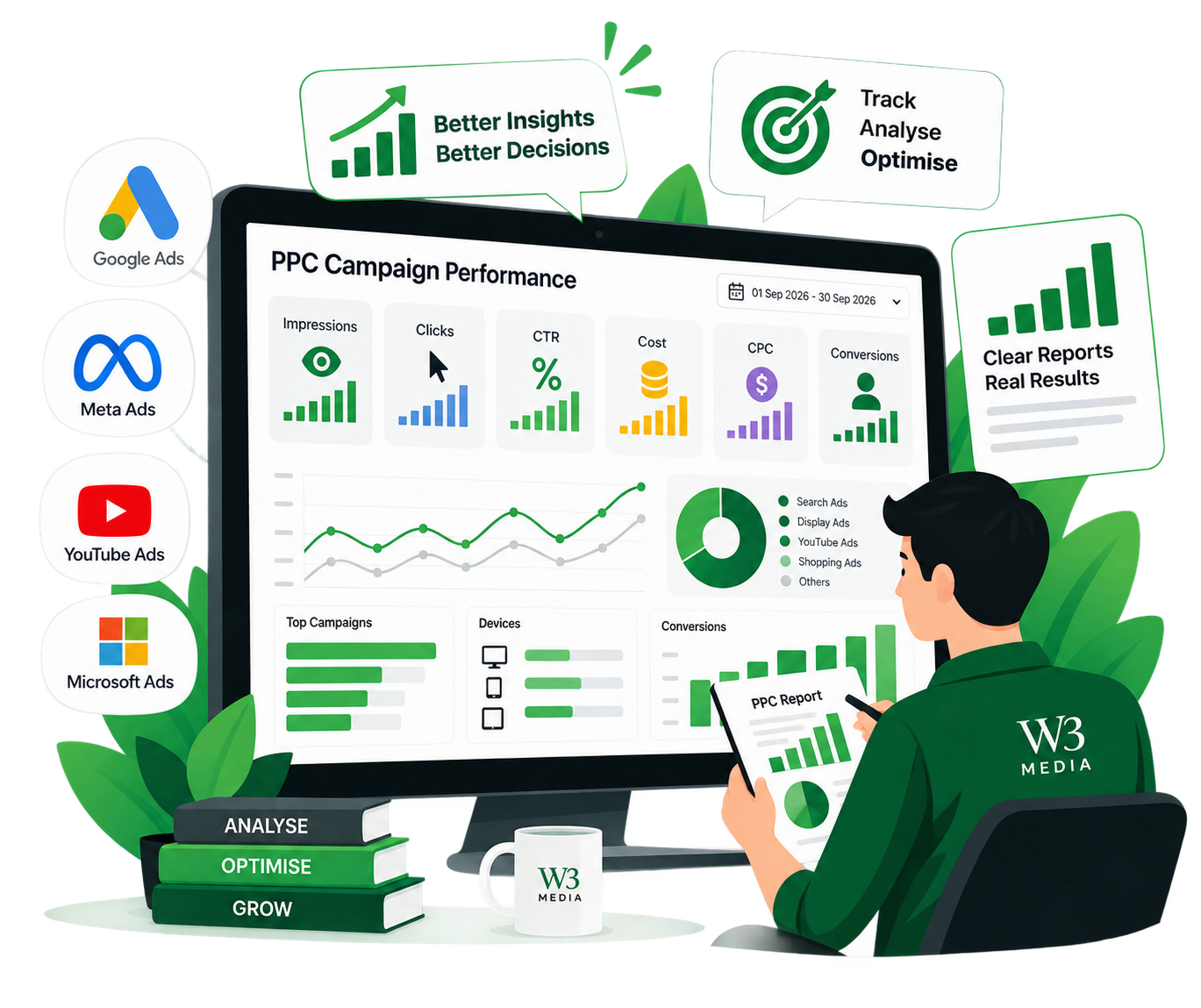
Different PPC metrics answer different questions. A single number should not be used as proof that a campaign is commercially successful.
Recorded instances where an advertisement was shown according to the advertising platform.
Does not automatically prove brand awareness or sales.Recorded interactions with an advertisement that can help measure traffic generated by PPC activity.
A click does not automatically mean purchase intent.Click-through rate compares recorded clicks with recorded advertising impressions.
A higher CTR does not automatically mean greater profitability.Cost per click relates advertising spend to recorded ad clicks during the reporting period.
Lower CPC is not automatically better business performance.Configured actions recorded by the available advertising or measurement system.
A conversion does not automatically equal a sale.Advertising cost compared with the number of configured conversions recorded.
It should not be interpreted as profit by itself.Conversion tracking records selected actions. Attribution attempts to assign credit across marketing interactions and customer touchpoints.
Tracking accuracy can be affected by consent, cookies, browsers, devices, offline interactions, attribution settings and the availability of sales or CRM data.
Explore Data Analytics Setup & Reporting →Reporting should move from understanding the campaign objective to reviewing data, interpreting changes and supporting the next decision.
Review campaign objectives, important conversions, reporting periods and the information stakeholders need.
Review campaign data, conversion definitions and other relevant measurement sources before drawing conclusions.
Select useful metrics instead of filling a report with every number available inside an advertising platform.
Compare performance with appropriate periods while considering budget, campaign, tracking and market changes.
Separate measured facts, observations and possible explanations so campaign reporting remains clear.
Reporting can highlight issues or opportunities that may require PPC management, tracking, landing-page or analytics work.
Useful PPC reporting should make advertising performance easier to understand without turning platform metrics into unsupported business claims.
Keep reporting connected with paid advertising objectives, campaign structure and relevant PPC metrics.
Distinguish clicks, conversions, qualified leads, sales and revenue instead of treating them as the same outcome.
Interpret advertising metrics around campaign goals instead of ranking campaigns by traffic alone.
Consider conversion definitions, attribution limitations and data-quality issues when explaining performance.
Reporting findings can support W3 Media's separate PPC Campaign Management service when campaign changes are needed.
Connect PPC reporting with analytics and dashboard requirements when wider measurement infrastructure is needed.
Clear answers for businesses evaluating Google Ads and PPC campaign reporting in Sri Lanka.
PPC reporting is the process of organizing, reviewing and explaining data generated by paid advertising campaigns. Reports can cover metrics such as impressions, clicks, advertising cost, click-through rate, cost per click and configured conversions while providing context around what those measurements mean.
A useful PPC report should include metrics that relate directly to the campaign objective. Depending on the campaign, this can include spend, impressions, clicks, click-through rate, CPC, conversions, conversion rate, cost per conversion, search-term insights and revenue-related metrics when suitable revenue tracking is available.
PPC reporting focuses on measuring, organizing and interpreting campaign performance. PPC management involves taking ongoing actions such as adjusting budgets, reviewing search terms, updating negative keywords, changing targeting, testing advertisements and improving landing-page alignment. Reporting provides information that can support those management decisions.
The most useful metrics depend on the campaign objective. Common measurements include impressions, clicks, click-through rate, average CPC, conversion rate, cost per conversion and advertising spend. Campaigns connected to measurable revenue may also review conversion value and ROAS. Metrics should be interpreted together rather than in isolation.
Not necessarily. A PPC conversion is an action configured for measurement, such as a form submission, phone call, booking, registration or purchase. If the conversion represents an enquiry, it does not automatically mean a sale occurred. Reports should clearly explain what each tracked conversion represents.
CPC, or cost per click, represents the average amount paid for a click on an advertisement. Cost per conversion measures advertising cost relative to the number of tracked conversion actions. A campaign can therefore have a relatively low CPC but a higher cost per conversion if many clicks do not complete the intended action.
ROAS means return on ad spend and compares tracked revenue or conversion value with advertising spend. It is most meaningful when reliable monetary values are available for the conversions being measured. If a campaign tracks only enquiries without verified revenue values, reporting a true revenue-based ROAS may not be appropriate.
No. ROAS normally compares revenue or conversion value with advertising spend. ROI is a broader business measure that can take additional costs and profit into account. A campaign can show a positive ROAS while the overall profitability of the activity may look different after product, staffing, fulfilment or other business costs are considered.
Not always. PPC reporting can track many digital actions when suitable tracking is configured, but attribution can be affected by factors such as consent settings, device changes, offline sales, phone conversations, tracking limitations and customer journeys involving several channels. Reports should distinguish measured results from assumptions or modeled attribution.
Google Ads and analytics platforms can report different numbers because they may use different attribution rules, reporting dates, conversion definitions, identity methods and processing approaches. Tracking configuration and consent settings can also affect recorded data. Small differences do not automatically mean that one platform is incorrect.
Review frequency depends on campaign size, spend and activity. Active campaigns may require regular operational checks, while formal performance reports can be prepared at agreed intervals such as monthly or around specific campaign periods. Reporting should be frequent enough to identify meaningful changes without making decisions based only on short-term fluctuations.
Reporting can highlight opportunities such as stronger search terms, underperforming targeting, inefficient spend, landing-page issues or differences between campaigns. The next step is to evaluate the finding and decide whether a campaign-management, creative, targeting, bidding, budget or website change is appropriate. Reporting itself does not automatically make those changes.
Turn available paid-advertising data into clearer campaign reporting, better-defined metrics and more informed PPC decisions.
Discuss Your PPC Reporting →Your next level of growth starts here. Partner with W3 Media to unlock your business’s true digital potential through tailored strategies, innovative solutions, and data-driven insights. Together, we’ll help you achieve measurable results and stand out in today’s competitive market.
We use cookies to give you the best experience. Cookie Policy