





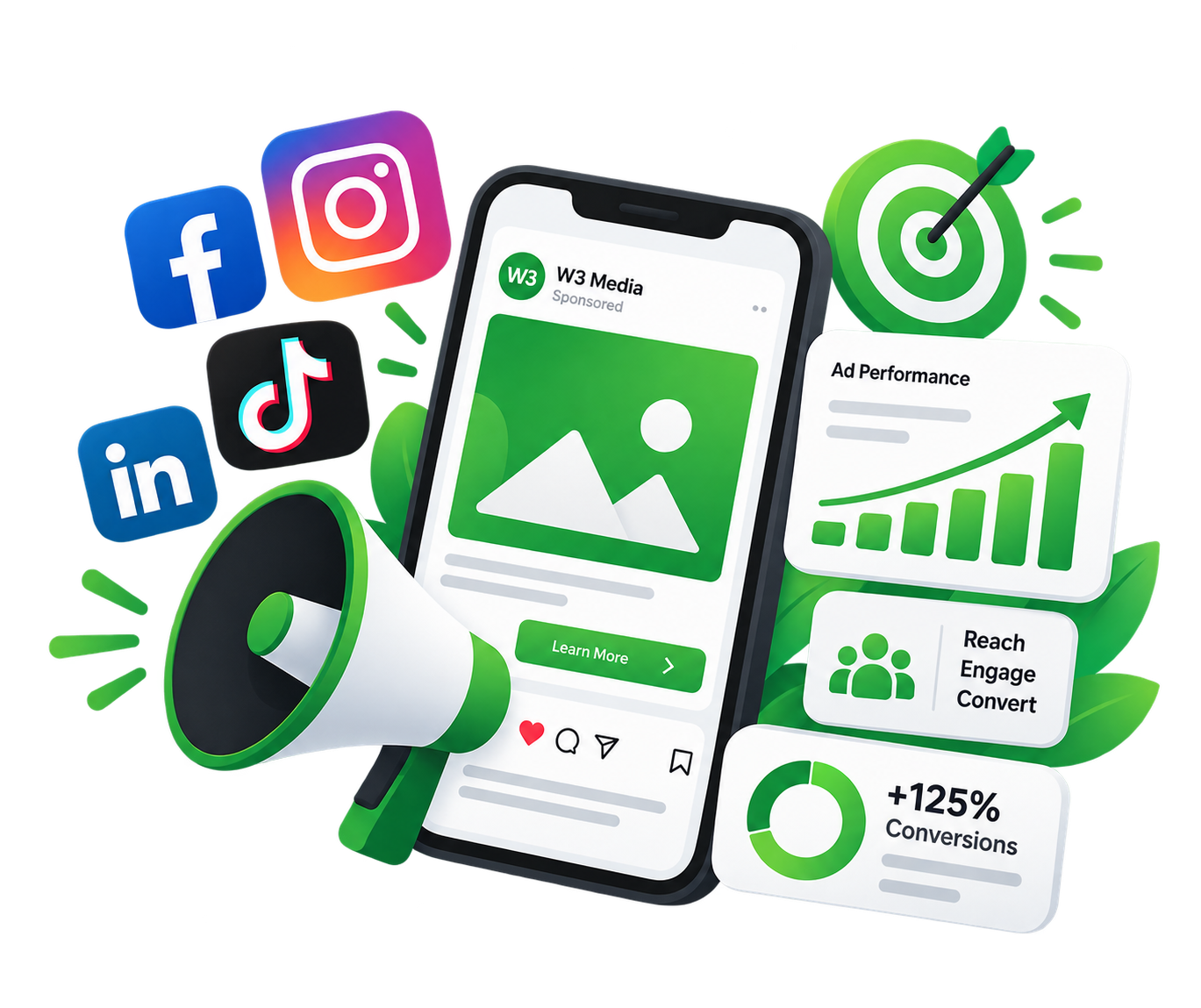
Campaign Strategy & Planning
Connect the campaign objective with the intended audience, message, creative direction, platform, budget, destination and measurement requirements.

Plan and manage paid social campaigns around clear objectives, relevant audiences, campaign-ready ad creative and measurable actions. W3 Media connects strategy, audience targeting, ad creative, copywriting, testing, budget management and conversion tracking within a structured social media advertising approach.
STRATEGY • CREATIVE • ADS • GROWTH
Social media advertising should begin with a defined campaign objective rather than simply increasing ad spend or promoting posts without a clear reason.
Social media advertising is the use of paid campaigns on social platforms to distribute advertisements to selected audiences based on a campaign objective, available targeting criteria, creative, messaging, budget and performance data.
Paid distribution can increase campaign visibility, but it does not guarantee leads, sales, conversions or return on advertising spend.
Define the purpose
Define relevant groups
Connect visual + message
Review relevant data
Our paid-social service connects the core activities needed to plan, create, launch, test and measure social advertising campaigns.
Connect the campaign objective with the intended audience, message, creative direction, platform, budget, destination and measurement requirements.
Configure relevant advertising audiences using the options available within the selected social advertising platform.
Compare defined campaign variations to learn how changes in creative, copy or another controlled element affect campaign performance.
Review campaign information using metrics that match the original objective rather than relying on a single metric for every campaign.
Develop campaign-ready visual creative that connects the audience, campaign message and objective while maintaining appropriate brand consistency.
Build concise campaign messaging that explains the offer or message, provides relevant context and supports an appropriate next action.
Approach campaign budget allocation and bidding according to the objective, audience, campaign duration and available advertising requirements.
Configure appropriate tracking to help connect eligible advertising interactions with relevant website actions and campaign measurement.
W3 Media's social advertising scope includes paid campaign activity across Facebook, Instagram, LinkedIn and TikTok. Platform selection should follow the intended audience, message, creative context and campaign objective.
Every business does not need every platform. A clearer campaign starts by deciding who needs to see the message and what action the campaign is intended to support.
Google Ads and paid search belong within the wider PPC advertising environment rather than being classified as social platforms.
Explore PPC AdvertisingPaid campaigns combining campaign objectives, available audience controls, visual creative, copy and measurement.
Visually focused paid campaigns using creative and messaging adapted to the intended audience and campaign requirement.
Paid advertising that may be relevant for professional audiences, B2B communication and service-focused campaigns.
Video-first paid campaigns where audience relevance, platform-native presentation and campaign measurement remain important.
Keeping these disciplines separate helps businesses choose the right service and helps search engines understand what this page is about.
| Area | Social Media Advertising | Organic Social | Google Ads / Search PPC |
|---|---|---|---|
| Distribution | Uses paid placements on social platforms | Uses normal account publishing | Uses paid search and other paid advertising environments |
| Audience | Uses available social-platform audience controls | Distribution depends on account, content and platform context | Search campaigns can use keyword and search-intent signals |
| Creative | Visual and video creative can be central | Supports ongoing social communication | Search formats can place greater emphasis on text and intent |
| Budget | Requires advertising media spend | Normal posting does not require media spend | Requires paid-media budget |
| Purpose | Supports defined paid campaign objectives | Supports ongoing brand communication | Search advertising can capture existing search demand |
A structured process keeps campaign decisions connected to the original business objective instead of treating individual ads as isolated activities.
Discuss Your CampaignReview the business, audience, offer, campaign objective, platform, destination and measurement requirements.
Align objective, audience, creative direction, messaging, budget approach and measurement.
Develop campaign-ready image or video creative together with the advertising copy required for the campaign.
Configure campaign settings, audience targeting, budget and testing, then use relevant data to support ongoing decisions.
Review relevant campaign information against the objective without assuming success before performance is evaluated.
W3 Media connects paid social advertising with wider digital capabilities while keeping campaign planning, creative, tracking and related marketing requirements clearly aligned with the intended objective.
Campaign decisions are connected to a defined objective, audience and measurement requirement.
Image/video creative and ad copywriting can be developed as part of the paid-social campaign.
Conversion tracking and campaign reporting support more informed evaluation of paid advertising activity.
Paid social can connect with W3 Media's wider social media, content, PPC and website capabilities where separately required.
Clear answers for Sri Lankan businesses reviewing paid social campaign strategy, audience targeting, creative testing, conversion tracking and advertising measurement.
Social media advertising is the use of paid campaigns on social platforms to reach selected audiences with promotional or informational messages. A campaign can combine audience targeting, ad creative, copy, budget allocation, testing and performance measurement around a defined marketing objective.
Social media marketing is the broader activity of building and managing a brand's presence across social platforms. It can include strategy, organic content, community activity, reporting and paid promotion. Social media advertising refers specifically to the paid campaign component.
Organic social media refers to unpaid posts and content published through a brand's normal social presence. Paid social uses advertising budgets to distribute selected messages to targeted audiences. Businesses can use both approaches together, depending on their communication and campaign goals.
Social media advertising generally reaches users within social platforms using audience, behavioural and interest-based signals together with creative formats. Google Ads can reach users through search, display, video and other Google advertising environments. The right channel depends on campaign objectives, audience behaviour and search intent.
Audience targeting is the process of defining which groups of users a paid social campaign should attempt to reach. Depending on the platform, targeting can use factors such as location, demographics, interests, behaviours, existing customer data or previous interactions with a business's digital properties.
A/B testing compares different versions of an ad or campaign element to understand which performs more effectively under the selected conditions. Tests may compare creative, headlines, copy, calls to action, audiences or other variables. Results should be interpreted using enough data and a clearly defined campaign objective.
Conversion tracking helps connect advertising activity with selected actions such as enquiries, purchases, registrations or other meaningful website events. When implemented appropriately, tracking can help businesses evaluate campaign outcomes and make more informed decisions about audiences, creative and advertising spend.
Ad spend is the budget paid to the advertising platform for campaign delivery. An agency management fee covers professional work such as planning, setup, audience targeting, creative coordination, optimization and reporting. These are separate cost areas and should be clearly explained within the campaign scope.
Not always, but paid social creative should be evaluated according to the campaign objective, audience and placement. Organic content can sometimes be adapted for advertising, while other campaigns may require dedicated visuals, video, messaging or calls to action designed specifically for paid distribution.
Relevant metrics depend on the campaign objective. They can include reach, impressions, click-through rate, cost per click, engagement, conversions, cost per conversion, revenue or return on ad spend. Reporting should focus on metrics that help explain whether the campaign is achieving its intended business or communication goal.
Connect campaign strategy, audience targeting, creative, copywriting, budget management and conversion tracking with W3 Media's social media advertising services..
Discuss Your Ad Campaign →Your next level of growth starts here. Partner with W3 Media to unlock your business’s true digital potential through tailored strategies, innovative solutions, and data-driven insights. Together, we’ll help you achieve measurable results and stand out in today’s competitive market.
We use cookies to give you the best experience. Cookie Policy