
Integrated Digital Capability
Connect SEO, paid advertising, social media, content, website development and reporting within one digital strategy.
We help hotels, resorts and accommodation businesses in Sri Lanka grow visibility across search, social media, paid advertising and direct bookings — turning travellers into guests, and guests into loyal advocates.
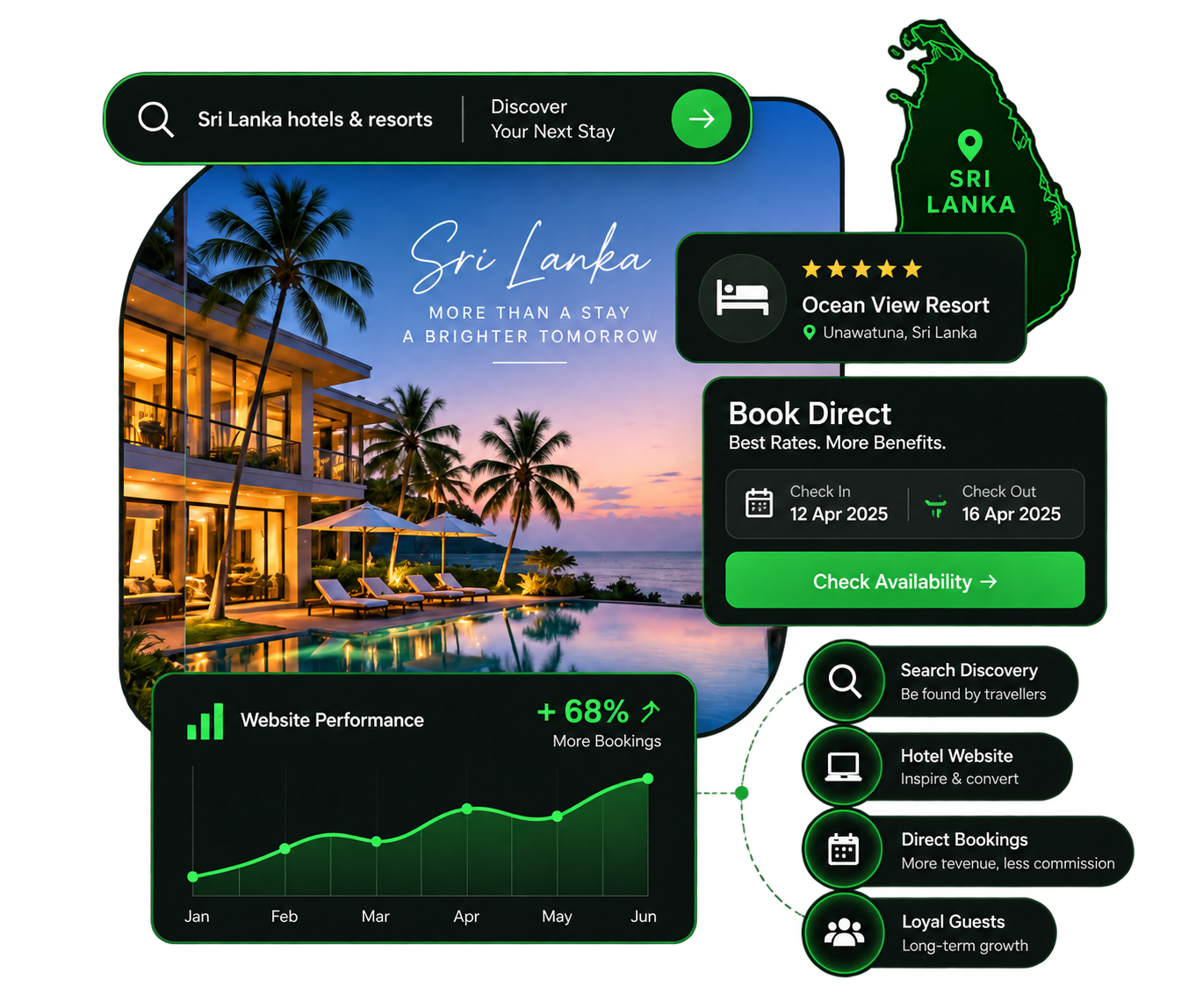
Digital marketing for hotels is the use of search, advertising, social media, websites, content, email, reviews and analytics to help accommodation businesses become discoverable and support traveller booking decisions.
A traveller may discover a property through Google Search, Google Maps, a destination article, an OTA, Instagram, TikTok, YouTube or a paid advertisement before visiting the hotel's own website. They may then compare location, rooms, facilities, reviews, pricing, photographs and nearby experiences before deciding where to book.
A strong hotel digital marketing strategy therefore needs to connect discovery, trust, website experience and measurable booking actions instead of treating each marketing channel separately.
Hotel SEO helps search engines understand your property, location, rooms, facilities and destination relevance so potential guests have more opportunities to discover the hotel when researching accommodation.
Research destination, property type, facility, room and traveller-intent searches relevant to your hotel.
Create useful pages for rooms, suites, restaurants, weddings, conferences and other important hotel offerings.
Develop helpful content around local attractions, experiences, transportation and traveller planning questions.
Review crawlability, indexability, page speed, mobile usability, internal linking and structured data where appropriate.
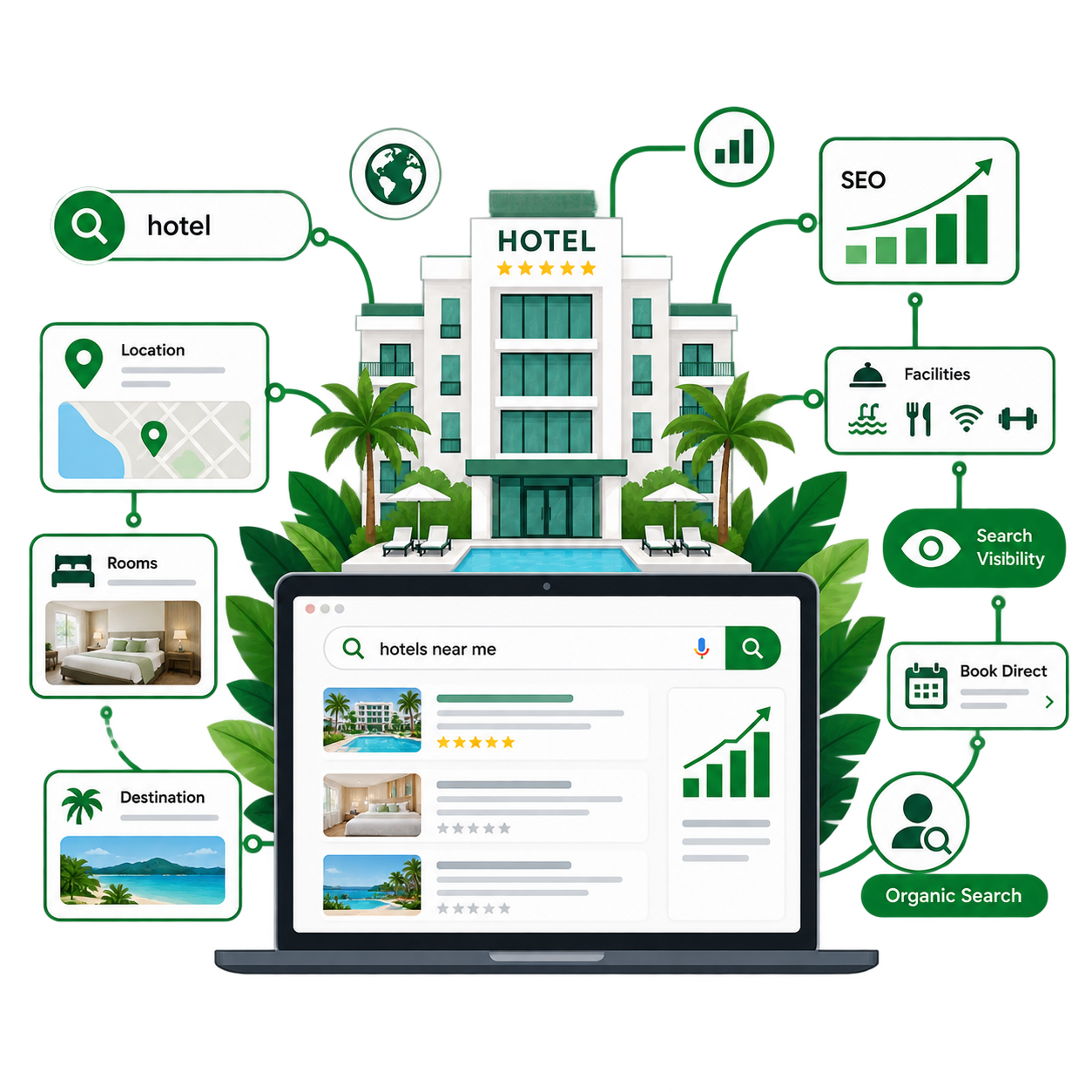
Hotels are location-based businesses. Accurate property details, location relevance and a well-maintained Google Business Profile can support discovery when travellers research accommodation through Search and Maps.
Keep hotel name, location, contact information, website and important property details consistent.
Encourage genuine guest feedback and respond professionally to reviews without using manipulative review practices.
Explain nearby attractions, neighbourhood information and practical travel details that genuinely help potential guests.
The hotel website is where travellers can explore the property without the distractions of a comparison marketplace. Clear room details, strong photography, mobile usability and visible booking actions can make that journey easier to understand.
Traveller discovers the hotel through search, social, advertising or referral.
They review rooms, facilities, photographs, location and nearby experiences.
Property details, reviews and available offers are compared with alternative accommodation.
Clear policies, accurate images, contact information and useful content strengthen confidence.
The user continues to the configured booking engine, enquiry channel or reservation process.
Paid search can help hotels appear for relevant traveller searches while campaigns are active. Strategy can vary between brand searches, destination searches, seasonal campaigns, special offers and different geographic audiences.
Build campaigns around traveller searches that reflect the hotel's actual property and offer.
Separate domestic and selected international audiences when campaign objectives require it.
Match campaign messaging with relevant room, offer, event or hotel landing pages.
Measure configured booking, enquiry or booking engine actions where the technical setup makes that measurement possible.
Instead of viewing SEO, paid advertising, social media and websites as separate activities, W3 Media can connect relevant channels around the hotel's customer journey and business objectives.
Connect SEO, paid advertising, social media, content, website development and reporting within one digital strategy.
Build strategies with local market context while also considering international traveller discovery where relevant.
Use traveller intent, destination demand and property relevance to guide organic and paid search decisions.
Consider the website experience and booking journey alongside traffic acquisition rather than focusing only on impressions and clicks.
Review available campaign and website data to understand performance and identify practical opportunities for refinement.
Choose channels based on the hotel's goals, audience, market, resources and available content rather than forcing every hotel into the same plan.
Practical answers for hotels and resorts evaluating digital marketing services in Sri Lanka.
Digital marketing for hotels uses channels such as websites, SEO, paid advertising, social media, email, content and online reputation management to help potential guests discover, evaluate and contact or book a property. The strategy can support brand visibility, direct booking activity and communication throughout the guest journey.
Travellers often research destinations, accommodation, room types, facilities, reviews and prices online before making a booking decision. Digital marketing can help Sri Lankan hotels and resorts present accurate information, reach relevant local and international audiences and support travellers during that research process.
Digital marketing can support direct bookings by helping travellers discover the hotel's official website, understand rooms and facilities and reach an appropriate booking or enquiry path. SEO, advertising, social media, email and a clear booking experience can all contribute, but direct booking volume cannot be guaranteed.
Hotel SEO is the process of improving a hotel's website so search engines can better understand the property, location, rooms, facilities, experiences and destination relevance. It can involve keyword research, technical SEO, room and facility pages, local optimization, content, internal linking and image optimization.
Hotel SEO does not have one fixed timeframe. Progress depends on the existing website, competition, destination search demand, technical issues, content quality, local visibility and competing hotel websites. Some improvements may appear earlier than others, while competitive searches can require sustained work over time.
Google Ads can be useful when a hotel wants paid visibility for selected destination, accommodation, room or brand-related searches. Whether it is suitable depends on search demand, competition, budget, landing-page quality, booking experience and the campaign objective. Paid advertising does not guarantee bookings.
SEO and Google Ads serve different purposes. SEO focuses on building organic search visibility over time, while Google Ads can provide paid visibility more quickly for selected searches. Many hotels can benefit from using both strategically rather than treating them as direct replacements for one another.
Local SEO helps search engines and travellers understand where a hotel is located and how it relates to destination-based searches. This can include accurate Google Business Profile information, consistent business details, location content, reviews and relevant local signals. Local SEO can support visibility but cannot guarantee specific map positions.
The right platforms depend on the hotel's audience and available content. Visual platforms can be useful for showcasing rooms, facilities, dining, experiences and destinations, while other channels may support advertising, customer communication or professional brand activity. Hotels should prioritize platforms that match their actual audience and marketing goals.
Not necessarily. Online travel agencies can provide reach and visibility to travellers who may not already know the hotel. Direct marketing can help strengthen the hotel's own website and booking channels, but the right balance between direct bookings and OTA distribution depends on commercial strategy, commission costs, market reach and occupancy goals.
Reviews can give prospective guests additional information about previous customer experiences and may influence trust during accommodation research. Hotels should encourage genuine feedback, monitor major review platforms and respond professionally. Fabricated reviews or misleading review practices should be avoided.
A hotel website should clearly present the property, location, room types, facilities, dining or experiences where relevant, photographs, policies, contact details and an appropriate booking or enquiry option. Mobile usability, website speed, security, clear navigation and accurate availability or pricing information are also important considerations.
W3 Media can support an integrated hotel digital marketing approach across relevant services such as SEO, paid advertising, social media, content, website optimization, analytics and reporting. The exact channel mix should be selected according to the hotel's objectives, target markets, available budget and internal operational needs.
No. Digital marketing can improve visibility, communication, website experience and opportunities for travellers to discover or contact a hotel, but it cannot guarantee bookings. Results are also affected by pricing, availability, destination demand, reviews, competition, seasonality, room quality, booking experience and other commercial factors.
Your next level of growth starts here. Partner with W3 Media to unlock your business’s true digital potential through tailored strategies, innovative solutions, and data-driven insights. Together, we’ll help you achieve measurable results and stand out in today’s competitive market.
We use cookies to give you the best experience. Cookie Policy